
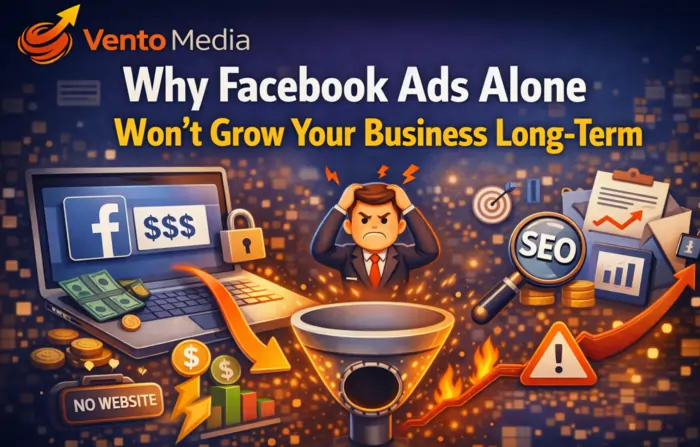
Facebook Ads are still powerful in 2026, but they’re interruption‑based, depend on rising media spend, and are vulnerable to algorithm and policy changes, so they can’t carry your growth alone. Serious businesses pair Facebook and Meta ads with SEO, Google Ads, Google Maps, and owned content so they can capture high‑intent searches, build long‑term trust, and avoid “rental” growth that disappears the moment the ad budget stops.
Use this article together with Why Your Website Isn’t Getting Traffic (And How SEO Fixes It) and No Leads From Your Website? Here’s What’s Missing to adjust your whole growth model—not just your ad campaigns.
1. Facebook Ads Are Interruption‑Based, Not Intent‑Based
On Facebook/Meta, people are scrolling to relax, chat, or be entertained—not actively searching for your service.
What this means:
- You’re “interrupting” people with your offer, hoping the targeting is right.
- Conversion cycles are longer, especially for B2B and high‑ticket services.
- Clicks are cheaper than Google in many niches, but buyer intent is lower.
Google Search & Maps, by contrast, capture people who are already looking for “dentist in Phnom Penh” or “SEO company Cambodia,” so intent is much higher. That’s why your SEOand local presence must grow alongside your ads.
2. When You Stop Paying, Facebook Stops Delivering
Facebook Ads are “rented” visibility: when the budget stops, the traffic stops.
Trends in 2025–2026:
- Ad costs (CPM/CPC) are rising in many verticals due to competition, creative fatigue, and algorithm changes.
- Performance volatility has increased; many advertisers report campaigns that suddenly stop working after updates.
By contrast, SEO builds assets:
- Pages, rankings, and backlinks continue to drive traffic for months or years.
- Organic ROI compounds over 12–24+ months as authority grows.
Over any horizon longer than about 12–18 months, SEO consistently beats paid ads on ROI, while paid remains useful for speed and testing.
3. Algorithms and Privacy Changes Make Ads Less Predictable
Facebook’s targeting has changed significantly after privacy shifts (e.g., iOS 14.5 and later updates).
Impacts:
- “Cold” targeting is less precise; the platform has less data to guess who your best buyer is.
- You rely more on your own first‑party data (pixel events, customer lists) and solid creative.
- Performance is great for experienced, data‑driven advertisers—but punishes guesswork.
If your whole growth model is just “boost posts and hope,” you’re tying your future to a system you don’t control. SEO, content, and email are slower to start but more stable once built.
4. Ads Are Great at Demand Creation, SEO Is Great at Demand Capture
In 2026, the most effective strategies use each channel for what it’s actually good at:
- Facebook Ads (Meta)
- Strengths: demand generation, awareness, retargeting, nurturing.
- Role: introduce your brand, build audiences, stay top‑of‑mind.
- Google Search, Maps, and SEO
- Strengths: demand capture—users with clear intent, ready to book, call, or buy.
- Role: convert people who are actively looking for what you offer.
Long‑term growth comes from integration, not choosing one over the other: ads bring new eyes, SEO and local presence turn that attention into reliable, compounding leads.
5. In the AI Era, You Need More Than One Channel
AI Overviews on Google and AI‑assisted discovery are changing how people find and evaluate businesses.
Key shifts:
- Organic click share has dropped in many sectors, while text ads have gained some share.
- Zero‑click rates are stable or up, meaning some questions are answered without any site clicks.
- Paid placements and AI‑aware messaging are bleeding into AI‑driven experiences (assistant recommendations, surfaces beyond the news feed).
If you only rely on Facebook Ads, you miss:
- High‑intent AI + search behavior.
- Brand searches and direct visits triggered by your earlier visibility.
You need your brand to show up in search, Maps, and AI Overviews, not just in a social feed.
6. Why Phnom Penh Businesses Get Stuck on the “Ads Hamster Wheel”
For Phnom Penh and Cambodian SMEs, it’s easy to get short‑term wins from Facebook and then stop there.
Common pattern:
- Launch Facebook campaign → get leads.
- Never invest in SEO, content, or Google Maps.
- Ad costs rise, performance dips, competition copies your approach.
- Growth stalls the moment budgets are cut.
To break this cycle, combine this guide with:
- Why Your Website Isn’t Getting Traffic (And How SEO Fixes It)
- No Leads From Your Website? Here’s What’s Missing
- Local SEO in Phnom Penh and your Maps/GBP guides.
7. How to Use Facebook Ads the Right Way (Alongside SEO)
Instead of treating Facebook Ads as your entire strategy, treat them as amplifiers and accelerators.
Better uses of Facebook Ads:
- Test offers and messaging quickly, then build SEO landing pages around winners.
- Retarget visitors who found you via Google Search or Maps.
- Amplify content that already performs well organically—guides, reviews, case studies.
Meanwhile, SEO and local work should:
- Make sure you’re visible and trusted when people search for you after seeing an ad.
- Provide in‑depth content (like your education and troubleshooting clusters) that ads can push more people into.
- Reduce your cost‑per‑lead over time as more leads come from organic channels.
8. Building a Long‑Term Growth Mix for Cambodia
A healthier model for Cambodian businesses looks like this:
- Short‑term: Facebook Ads (and possibly Google Ads) to get leads now.
- Mid‑term: SEO content, Google Maps, and reviews to build persistent visibility.
- Long‑term: Brand recognition, direct traffic, email list, and referrals driven by everything above.
Your existing clusters map to this:
- Education: explains SEO and builds trust.
- Local: gets you into Maps and local packs.
- Mistakes/troubleshooting: catches owners when things aren’t working and offers a path forward.
FAQs: Why Facebook Ads Alone Won’t Grow Your Business Long‑Term
1. Are Facebook Ads “dead” in 2026?
No. Facebook Ads still work and can be very profitable, but they’re more competitive, less forgiving, and no longer something you can improvise without data and strategy.
2. Why can’t I rely only on Facebook Ads for growth?
Because they stop the moment you stop paying, are vulnerable to algorithm and privacy changes, and don’t build long‑term assets like rankings, content, or brand search demand.
3. Are Facebook Ads or Google Ads better for my business?
They serve different roles: Facebook is better at demand creation and retargeting; Google Ads is better at capturing existing, high‑intent demand. Most successful businesses use both, plus SEO.
4. How do rising ad costs affect my strategy?
As CPMs/CPCs rise, your cost per lead goes up unless your funnel and creative improve. That makes it even more important to have SEO and organic channels offsetting acquisition costs.
5. What happens to my leads if I pause Facebook Ads?
Leads from Facebook quickly drop to near zero, especially if you have no other strong channels. SEO, Maps, and content continue producing leads even when ad spend pauses.
6. How do AI Overviews influence the balance between ads and SEO?
AI Overviews have reduced some organic clicks, but professional SEO still drives strong engagement and can outperform ads for long‑term ROI. Paid is important, but it’s not a substitute for organic trust.
7. Should I switch my entire budget from Facebook Ads to SEO?
Not usually. It’s better to gradually shift a portion of your budget into SEO, content, and local work while keeping profitable ad campaigns running for immediate results.
8. How can I tell if my Facebook Ads are masking a weak website?
If most of your leads come only from ads and organic channels (SEO, direct, Maps) barely convert, your website likely has messaging, UX, or trust issues.
9. Can Facebook Ads work without a strong website or SEO?
They can generate some leads, but you’ll pay more for each one, and your follow‑through (nurture, search behavior, research) will be weaker without a strong site and organic presence.
10. How should I use Facebook Ads together with SEO?
Use ads to:
- Test offers and messages.
- Retarget SEO and Maps visitors.
- Boost your best organic content.
Use SEO to: - Capture search intent.
- Provide depth and trust.
- Lower long‑term cost per lead.
11. What role do Google Maps and local SEO play here?
Maps and local SEO help you appear when people search “near me” or by city. Many will search your name after seeing a Facebook ad; you want to look strong there, not invisible.
12. Do Facebook’s own AI tools solve my growth problems?
Meta’s AI targeting and creative tools can help, but they don’t fix weak offers, poor landing pages, or missing SEO. They amplify what’s already working, not what’s broken.
13. Should I diversify beyond just Facebook and Google?
Yes, over time: email, YouTube, TikTok, niche directories, and partner traffic can all reduce reliance on any single platform while building more durable visibility.
14. How long does it take for SEO to overtake ads in ROI?
Many analyses show SEO winning clearly over periods longer than 12–18 months, thanks to compounding rankings and authority. In the first few months, ads usually win on speed.
15. What if Facebook Ads are working great for me right now?
Great—keep them. But start investing in SEO, Maps, and content so that if performance drops or costs spike, your growth doesn’t collapse with one platform.
This article is produced by Vento Media Digital, the team behind VentoRich.com, helping Cambodian businesses turn SEO, local search, and paid channels like Facebook Ads into sustainable, compounding growth—instead of short‑term spikes.
