

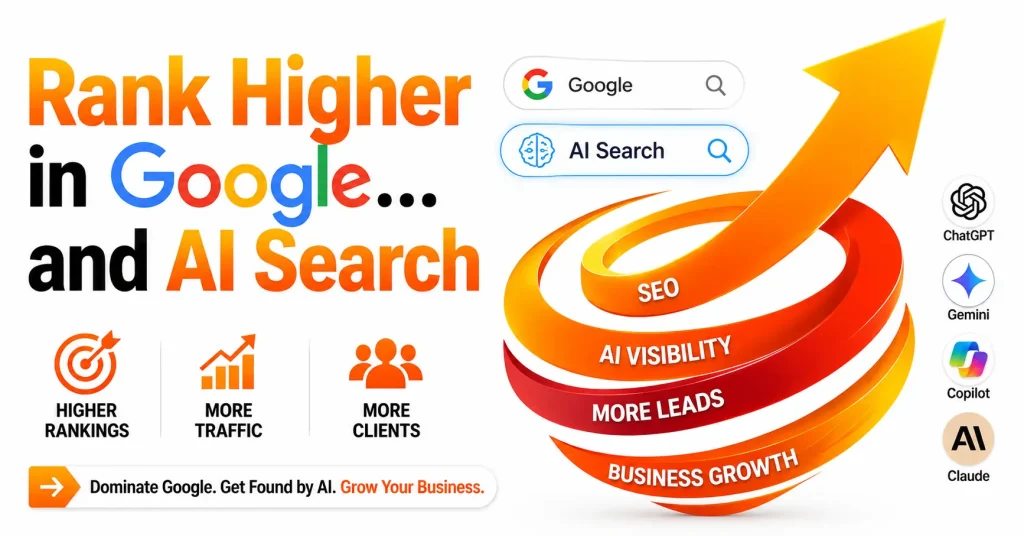
Rank Higher in Google and AI Search Key Takeaways
Businesses that adapt early will capture the growing share of zero-click searches and AI citations.
- Rank Higher in Google and AI Search requires optimizing for conversational queries, entity authority, and structured data — not just keywords.
- AI platforms like Gemini, Claude, and Copilot prioritize well-researched, citation-worthy content from authoritative sources.
- Multilingual and localized AI SEO 2026 strategies — including Khmer SEO and Cambodia SEO — unlock untapped visibility in emerging markets.
Why Rank Higher in Google and AI Search Demands a New Playbook
Traditional SEO focused on keywords, backlinks, and meta tags. That approach still matters, but it is no longer sufficient. AI search models — from Google’s AI Overview to ChatGPT, Gemini, Perplexity, and Bing Copilot — interpret content differently. They look for semantic relevance, entity relationships, and trustworthy signals. If your content does not speak the language of LLMs, you will vanish from AI-generated answers.
Businesses that adapt early will capture the growing share of zero-click searches and AI citations. Those that ignore this shift risk losing visibility entirely. The goal is not just to appear on page one but to become the cited source inside AI responses.
Understanding the AI Search Ecosystem in 2026
Today’s search landscape includes multiple AI-powered surfaces. Each has its own ranking logic. Knowing how they differ is the first step to building an effective AI SEO 2026 strategy.
Google AI Overview and SGE Optimization
Google’s AI Overview (formerly SGE) generates summarized answers at the top of search results. It pulls from pages that demonstrate topical authority, clear entity SEO, and strong EEAT SEO signals. To appear, your content must be structured in a way that AI can easily parse. Use FAQ schema, content clusters, and passage ranking optimization.
ChatGPT SEO and Gemini SEO
ChatGPT and Gemini are conversational answer engines. They rely on retrieval augmented generation (RAG SEO) to pull real-time information from indexed web pages. To get cited, your content must be AI-friendly content — clearly written, citation-ready, and rich with semantic keywords and entity relationships. ChatGPT SEO and Gemini SEO favor pages that answer specific questions with direct, well-sourced facts.
Claude AI SEO and Perplexity SEO
Claude AI and Perplexity prioritize depth and accuracy. They often cite academic sources, reputable news, and authoritative niche sites. Claude AI SEO rewards long-form, well-structured guides with transparent sourcing. Perplexity SEO values pages that appear as top citations across multiple queries. Building AI citation SEO and digital authority is essential for these platforms.
Copilot SEO and Bing AI Search
Microsoft’s Copilot and Bing AI use a combination of traditional Bing ranking signals and LLM relevance scoring. Copilot SEO and Bing Copilot SEO require clean structured data, strong author authority, and contextual backlinks. Optimizing for Bing also helps with Microsoft AI search optimization.
Core Strategies to Rank Higher in Google and AI Search in 2026
The following strategies form the backbone of a future-proof AI SEO playbook. Each tactic directly impacts how LLMs and AI overviews evaluate your content.
Build Topical Authority with Content Clusters
Topical authority is a key ranking factor for both Google and AI answer engines. Instead of writing isolated articles, create interconnected content clusters around a central pillar topic. For example, a cluster on “AI SEO 2026” might include pillar content plus supporting articles on semantic SEO, entity SEO, voice search SEO, and multimodal SEO. Use semantic internal linking to strengthen entity signals.
Optimize for Conversational and Long-Tail AI Keywords
AI search queries are often phrased as natural language questions. Target conversational search SEO and long-tail AI keywords like “How do I optimize for Google AI Overview?” or “What are the best AI SEO strategies for 2026?”. Include natural language SEO patterns throughout your content. Use LSI keywords and semantic keywords to improve contextual relevance.
Leverage Structured Data and Schema Markup
Schema markup SEO helps AI understand your content’s structure and entities. Implement FAQ schema, HowTo schema, Article schema, and knowledge graph SEO markup. Structured data optimization improves your chances of appearing in featured snippets optimization, People Also Ask SEO, and AI-generated snippets. Test your markup with Google’s Rich Results Test.
Strengthen EEAT and Author Authority
EEAT SEO (Experience, Expertise, Authoritativeness, Trustworthiness) remains critical for AI ranking. Showcase author authority SEO with detailed author bios, credentials, and links to external publications. Include trust signals SEO such as citations, data sources, and client logos. Digital brand authority and brand entity optimization signal to AI that your content is reliable.
Create Answer-Focused, Citation-Worthy Content
Answer engine marketing (AEO) means structuring content to directly answer user questions. Write clear, concise answers at the top of your articles, then expand with supporting evidence. Use bullet points, tables, and callout boxes to make key facts stand out. Citation-worthy content that other authoritative sites reference is the gold standard for AI citation building.
Optimize for Zero-Click Search and AI Snippets
Zero-click search optimization targets the featured snippet position. AI overviews often pull from the same content. Use featured snippets optimization techniques: define terms clearly, use numbered steps, and answer questions directly. People Also Ask SEO helps you capture related queries. Monitor AI-generated snippets to see what content gets cited.
Focus on Semantic and Entity SEO
Semantic SEO and entity SEO help AI understand the relationships between concepts. Instead of repeating the same keyword, build a network of related terms and entities. For example, content about AI overview optimization should also mention vector search optimization, RAG SEO, and NLP SEO. Use knowledge graph SEO to connect your brand with relevant entities.
Platform-Specific Tactics for AI SEO 2026
Each AI platform has unique ranking preferences. Tailor your approach to maximize visibility across all major surfaces.
Optimizing for Google AI Overview
Google’s AI Overview pulls from pages with strong generative engine optimization (GEO). Ensure your content includes clear headings, concise summaries, and FAQ schema. Use passage ranking optimization to help AI isolate the most relevant sections. Include AI-friendly headings that mirror natural language questions.
Ranking in ChatGPT Search Results
ChatGPT favors content that is factual, well-cited, and directly addresses user queries. ChatGPT discoverability improves when your site has high domain authority and contextual backlinks. Use AI content discoverability best practices: include metadata, schema markup, and clear authorship.
Visibility on Gemini AI and Claude AI
Gemini and Claude both prioritize depth and originality. Gemini AI visibility increases with structured data and entity-rich content. Claude-friendly content should include transparent sourcing, detailed explanations, and a logical flow. Both models favor content that demonstrates expert content SEO and trustworthy content optimization.
Appearing in Perplexity AI Answers
Perplexity often cites content from Wikipedia, news outlets, and niche authority sites. To appear in Perplexity AI answers, focus on AI citat