
My 18 Years in SEO: What Still Works in 2026. I’ve been doing SEO long enough to see every “SEO is dead” headline, every new Google update, and now AI Overviews, LLMs, and tools like ChatGPT, Gemini, Claude, Perplexity, and Copilot take over everyone’s feeds. Under all that noise, the same things still move the needle in 2026: technically clean sites, experience‑driven content, sane link and brand building, and a strategy that respects users more than loopholes—whether I’m in classic mode or using every AI mode and LLM helper available.
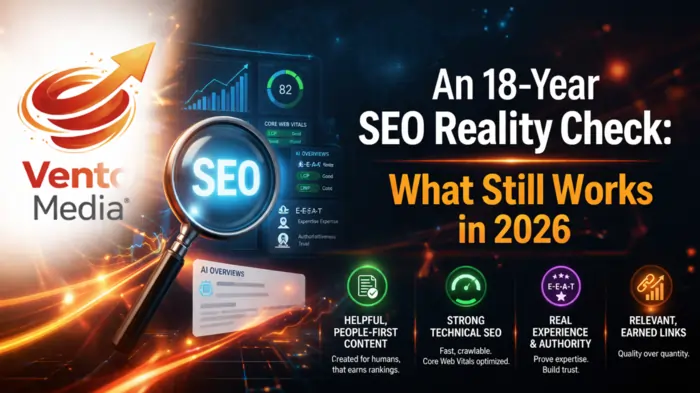
In 2026, what still works in SEO is surprisingly simple: understand search intent, publish genuinely useful content (with good structure and natural LSI/semantic keywords), keep your site fast and crawlable, build real authority over time, and use AI tools like ChatGPT, Gemini, Claude, Perplexity, and Copilot as assistants—not as “magic buttons.” If you get those fundamentals right, you can adapt to AI Overviews and every new update without rebuilding your entire strategy every six months.
This article anchors your new cluster, so I’ll naturally point readers to:
- SEO Strategies I Use for Clients in Asia (Real Insights)
- Case Study: How I Ranked a Website in 30–60 Days
- Grey Hat vs White Hat SEO: What Actually Works Today
- The Truth About SEO in 2026 (No BS Guide)
1. My 18 Years in SEO: What Actually Stayed the Same
When I look back at the last 18 years, I see tools, interfaces, and buzzwords change constantly—but the sites that win long‑term all do the same basic things well.
What hasn’t changed:
- Intent beats keywords
Pages that nail what the searcher is really trying to do—compare, decide, fix, buy—still beat pages over‑stuffed with keywords. That’s why in my The Truth About SEO in 2026 (No BS Guide), I talk more about intent than “keyword density.” - Helpful, lived‑experience content wins
Content grounded in real work, examples, and “this is what happened when we tried it” is outranking shallow explainers, especially now that low‑effort AI content is everywhere. You’ll see this style in SEO Strategies I Use for Clients in Asia and in my 30–60 day ranking case study. - Technical basics are non‑negotiable
Fast pages, mobile‑friendly layouts, clean internal linking, and a crawlable structure won’t make headlines, but if you ignore them, you’re fighting with a broken engine. - Honest authority and links still matter
Links from relevant, trustworthy sites and a recognizable brand still correlate strongly with rankings and visibility—even in an AI Overview world.
So when someone asks me “what still works in 2026?”, the answer is: the boring stuff, done consistently.
2. The Core Workflow I Still Use on Almost Every Site
If you stripped my work down to the essentials, this is the routine I still follow in 2026—whether I’m working with clients in Phnom Penh, Singapore, Manila, or beyond.
Step 1: Fix the foundation
- Run a proper technical audit (not just a screenshot of a tool).
- Fix crawl issues, bad redirects, broken internal links.
- Get speed and Core Web Vitals into a “good enough” zone, especially on mobile.
- Clean up messy navigation so Google and humans can see your main themes.
Step 2: Build topic clusters, not random posts
- Choose core themes (for VentoRich, things like: SEO basics, local SEO, mistakes/troubleshooting, hiring/pricing, and now this “experience + truth” cluster).
- Create a strong pillar page, then supporting articles that answer specific, related questions.
- Use natural LSI/semantic keywords in headings and body copy so Google and LLMs can map the topic properly.
Step 3: Invest in true evergreen assets
- Deep guides that will still matter in 3–5 years: how SEO works, why it matters, realistic timelines, choosing an agency, pricing, etc.
- Update them regularly instead of constantly chasing brand‑new topics.
Step 4: Earn authority the slow, honest way
- Pitch content worth linking to—case studies, data, or genuinely practical guides.
- Build a footprint on relevant sites in your region and niche (not random, low‑quality blogs).
This is the same engine under nearly every client success story I’ve had, including the one I unpack in How I Ranked a Website in 30–60 Days.
3. What Changed: AI Overviews, LLMs, and Why Structure Matters More
The biggest shift between my early days in SEO and 2026 isn’t “SEO vs AI,” it’s where users get answers and how those answers are stitched together.
Here’s what’s different now:
- AI Overviews and zero‑click results
- A lot more queries are answered directly on the results page via AI Overviews.
- That can reduce pure organic clicks for some queries, but when your site is cited or used as a source, you still gain visibility, trust, and even branded search later.
- LLMs and assistants are new “discovery layers”
- People now ask ChatGPT, Gemini, Claude, Perplexity, and other LLM assistants for recommendations before they even hit Google.
- Those assistants still lean heavily on sites that look authoritative, structured, and up‑to‑date.
- Structure and clarity are more important than ever
- Clear headings, summaries, bullet points, and FAQ sections make your content easier for both Google and AI mode answers to parse and reuse.
- Good use of semantic/LSI keywords around a topic helps models understand context and related questions.
That’s why in The Truth About SEO in 2026 (No BS Guide), I talk about optimizing not just for “10 blue links,” but for a mix of classic rankings, AI citations, and brand demand.
4. Tactics I’ve Watched Come and Go (And Why I Don’t Lean on Them)
After nearly two decades, I’ve seen the same types of shortcuts cycle through under new names.
Things I’ve learned to be very careful with:
- Pure loophole chasing
- Private link networks, aggressive expired domain tricks, doorway sites—they sometimes pop, but they rarely survive multiple updates or manual reviews.
- The clean‑up cost (or lost domain) often wipes out any “savings.”
- Mass‑produced, low‑value AI content
- Publishing hundreds or thousands of unedited AI articles with no experience, no local nuance, and no real usefulness gets ignored or quietly down‑ranked.
- AI‑only content farms are already struggling in real‑world tests.
- Micro‑tweaks with no strategy
- Obsessing over tiny on‑page “hacks” while ignoring content quality, UX, and authority is like rearranging chairs on a boat with a hole in it.
In Grey Hat vs White Hat SEO: What Actually Works Today, I’ll get more honest about where I draw the line and which “grey” tactics I still selectively consider after weighing risk vs reward.
5. How I Use AI Tools (Without Letting Them Drive the Car)
I use ChatGPT, Gemini, Claude, Perplexity, and Copilot almost every day—but never as a replacement for thinking or experience.
What these LLM tools are great for in my workflow:
- Research & ideation
- Getting a quick feel for a topic or SERP before I dive deeper.
- Brainstorming angles, subtopics, and FAQ ideas that I can validate against real data.
- Exploring related LSI/semantic keywords and entities.
- Drafting and editing support
- Roughing out outlines and first drafts that I then rewrite with my tone and local context.
- Helping re‑phrase or simplify complex explanations for business owners.
- Analysis & reporting
- Summarizing long reports.
- Clustering keywords or queries into themes.
- Spotting patterns in performance that I then sanity‑check in analytics.
What I don’t outsource to AI:
- Strategy: deciding which topics, pages, and links to prioritize.
- Risk decisions: how far I’m willing to push “grey” tactics for a specific client.
- Final content quality: especially anything that represents my name, my brand, or a client’s expert voice.
FAQ
So… after 18+ years in SEO, what still actually works?
Honestly? It’s simple.
Understanding what people are really searching for—and giving them exactly that.
Not tricks. Not hacks. Not keyword stuffing.
Just solving the user’s problem better than anyone else.
Is SEO still important now that AI is everywhere?
Yes—more than ever.
AI tools still need clear, trusted websites to get their answers from.
If your site is strong, structured, and helpful—you’re more likely to be the one they recommend.
Where do AI tools fit in SEO today?
Think of them as assistants, not replacements.
They help you:
- Research faster
- Generate ideas
- Draft content
But strategy, experience, and final decisions?
That still needs a real human.
Do you need to change everything because of AI?
Not really.
If your basics are solid, you’re already ahead.
You just need to:
- Structure content better
- Add FAQs
- Show real expertise
The core still stays the same:
👉 Good content. Good experience. Real authority.
Do keywords still matter?
Yes—but not in the old spammy way.
Using natural, related keywords helps search engines and AI understand your content better.
What about link building?
Still important.
But now it’s more about real mentions and credibility, not spam links.
Can I just use AI to create content?
You can—but don’t expect it to work long-term.
Low-quality, mass-produced content gets ignored.
People (and Google) still want useful, real, human value.
Does site speed still matter?
Yes—and it’s non-negotiable.
A slow site won’t just hurt rankings—it kills conversions too.
Do titles and headings still matter?
100%.
They help both Google and AI understand your content quickly.
White hat vs grey hat—what’s the real deal?
For most businesses, clean SEO is enough.
But in very competitive niches, some push the edge—but that always comes with risk.
Has user behavior changed?
Big time.
People want:
- Faster answers
- Cleaner pages
- More proof
And many discover brands through AI or social before searching on Google.
Long content or short content?
It’s not about length—it’s about how well you answer the question.
Some topics need depth.
Some just need a quick answer.
Should I update old content or create new?
Both—but updating old content is underrated.
Refreshing strong pages can bring back traffic faster than starting from scratch.
How do I future-proof my SEO?
Focus on what doesn’t change:
- Strong technical setup
- Content based on real intent
- Authority and trust
- Clean structure
Stop chasing shortcuts—they don’t last.
Can I rely only on AI tools?
You can start with them.
But without experience, it’s easy to do a lot of work that leads nowhere.
Is international SEO different?
The basics are the same.
But you need to understand:
- Language
- Local behavior
- Competition
How do I know if my site is AI-ready?
Ask yourself:
- Is my content clear and structured?
- Does it show real expertise?
- Is it actually helpful?
If yes—you’re on the right track.
Is evergreen content still valuable?
More than ever.
Good content keeps bringing traffic, links, and even AI mentions over time.
Should I worry about every Google update?
Not really.
If your foundation is solid, updates won’t hurt you much.
Final thought
SEO in 2026 isn’t about beating the system.
It’s about being the best answer—for users, for Google, and now… for AI.
If you want to see how this plays out on real sites, SEO Strategies I Use for Clients in Asia (Real Insights) and the 30–60 day case study will show the mix of fundamentals + selective AI use.
