
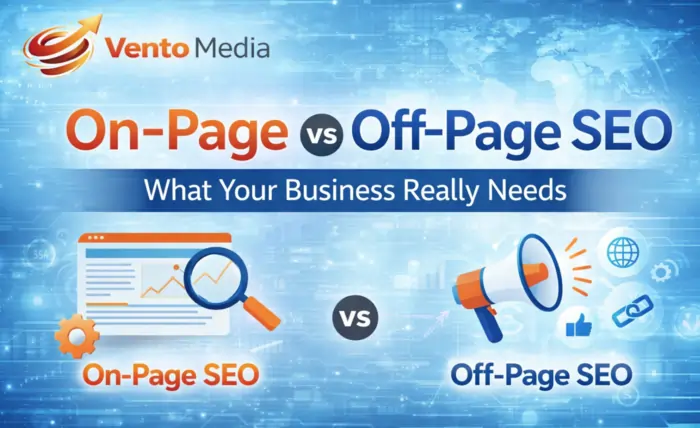
On-Page vs Off-Page SEO. On‑page SEO is everything you control on your own website—your content, keywords, structure, and internal links—while off‑page SEO is everything that happens away from your site, like backlinks, mentions, and reviews. For most Cambodian businesses, especially SMEs, your priority should be to get on‑page SEO and basic technical SEO right first, then build high‑quality off‑page signals (local backlinks, citations, and Google reviews) in a strategic, natural way. When both sides work together, Google can understand your business clearly and trust you enough to rank you above competitors.
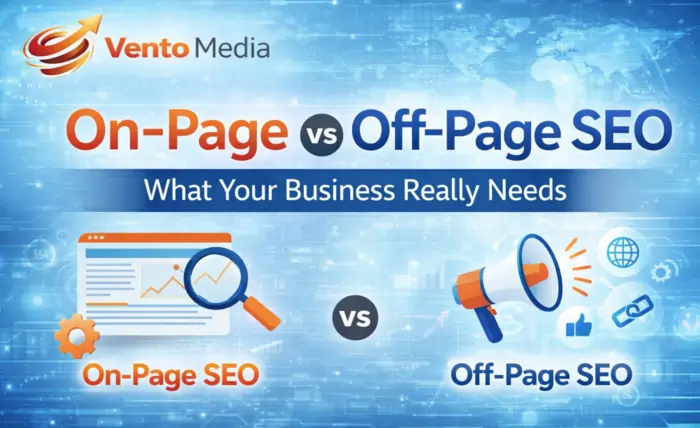
If you’re still unsure what SEO is in general, start with What is SEO and Why It Matters for Businesses in Cambodia. If you want the bigger picture of algorithms and AI, read How SEO Works in 2026: Simple Guide for Business Owners next. This guide focuses specifically on the “on‑page vs off‑page” decision so you know what to do first.
On-Page SEO: What Happens on Your Website
What on-page SEO actually includes
On‑page SEO covers all the optimizations you make on your own pages to help Google and users understand your content:
- Content and keywords: The text, headings, and topics you cover on each page.
- Title tags and meta descriptions: The snippets that appear in Google results.
- Headings (H1, H2, H3): How you structure information logically.
- Internal links: How your pages link to each other.
- Local signals: City names, neighborhoods, Khmer terms, and real local context.
When you get on‑page SEO right, each important page becomes a clear, targeted answer to a specific search.
Why on-page SEO is your first priority
For most Cambodian SMEs, on‑page SEO is where you should start because:
- It’s fully under your control—no begging others for links.
- It improves both SEO and conversions at the same time.
- Without strong on‑page signals, backlinks and reviews have less impact.
If you haven’t done this yet, start by structuring your site and pages using the frameworks in:
- How SEO Works in 2026: Simple Guide for Business Owners
- Technical SEO Explained in Plain English (No Jargon)
Off-Page SEO: What Happens Away from Your Website
What off-page SEO actually includes
Off‑page SEO is about building trust and authority for your business across the web. Key elements:
- Backlinks: Other websites linking to your pages.
- Brand mentions and PR: Being referenced in articles, directories, and media.
- Online reviews: Especially on Google Business Profile and niche platforms.
- Social and community signals: People talking about and interacting with your brand.
To Google, a website with strong off‑page signals looks more established and trustworthy than one that “screams” about itself but nobody else mentions.
Why off-page SEO is powerful—but risky if done wrong
Good off‑page SEO can be the factor that lifts you above similar competitors. But:
- Low‑quality, spammy links can hurt more than they help.
- Buying random links or fake reviews can trigger penalties or visibility drops.
- It’s harder to control and often slower to influence.
That’s why I recommend building clean, local off‑page signals after your on‑page and technical basics are in place, using strategies from:
- Top Local SEO Strategies for Phnom Penh SMEs
- Why Your Phnom Penh Business Is not Showing on Google (Fix This Fast)
Key Differences: On-Page vs Off-Page SEO
What each one influences
- On‑page SEO helps Google understand what your pages are about and who they’re for.
- Off‑page SEO helps Google judge how trustworthy and popular you are compared to others.
Think of on‑page as your CV (what you say about yourself) and off‑page as your references(what others say about you).
Effort, cost, and control
- On‑page SEO: More controllable, often lower direct cost, can be improved steadily by you or your team.
- Off‑page SEO: Requires relationship‑building, PR, partnerships, and time; quality matters more than volume.
For Cambodian SMEs with limited resources, it’s usually smarter to:
- Fix on‑page and technical basics.
- Build a handful of strong, relevant off‑page signals.
- Then scale both sides together.
Which Should You Focus on First?
If you’re just starting or your site is basic
If your website is small, outdated, or barely optimized, your top priority is on‑page + technical SEO:
- Create clear service and location pages.
- Fix titles, meta descriptions, and headings.
- Add real local context (Phnom Penh, city names, Khmer phrases).
- Make sure your site is mobile‑friendly and indexable.
You’ll find practical starting points here:
- What is SEO and Why It Matters for Businesses in Cambodia
- Technical SEO Explained in Plain English (No Jargon)
If your on-page is solid but rankings are stuck
If your pages are well‑structured and content is strong but you’re still stuck, you likely need more off‑page authority:
- Local backlinks from Cambodian sites (media, partners, directories).
- More and better Google reviews.
- Mentions from relevant blogs, associations, or industry resources.
This is especially true in competitive local niches in Phnom Penh.
How On-Page and Off-Page Work Together (Example)
Example: Dental clinic in Phnom Penh
On‑page SEO:
- A page optimized for “dental clinic in Phnom Penh” with clear services, pricing ranges, address, and FAQs.
- Local signals like neighborhood names (BKK1, Toul Tom Poung, Sen Sok), Khmer phrases, and map embedding.
- Internal links from blog posts like “How to choose a dental clinic in Phnom Penh.”
Off‑page SEO:
- Links from local health blogs, expat community sites, and Cambodian media.
- Dozens of Google reviews mentioning “dental clinic in Phnom Penh” and real experiences.
- Consistent listings in Cambodian directories and social pages.
Result: Google sees both relevance (on‑page) and prominence/trust (off‑page), making it much more likely to rank that clinic on Search and Maps.
For the local side of this equation, pair this article with:
- Local SEO in Phnom Penh: A Beginner’s Guide for Business Owners
- How to Rank Your Business on Google Maps in Phnom Penh (Step‑by‑Step)
Off-Page SEO That Actually Works for Cambodian SMEs
Focus on quality, relevance, and locality
Instead of chasing thousands of random links, prioritize:
- Local partnerships: Co‑marketing with other Phnom Penh businesses.
- PR and media: Features in Cambodian news sites and blogs.
- Industry links: Associations, suppliers, or platforms relevant to your niche.
- Local directories and platforms: Real Cambodian directories, booking sites, and marketplaces.
These build genuine authority and are safer long‑term than buying generic SEO packages.
Use reviews as part of your off-page strategy
For local businesses, Google reviews are a powerful off‑page signal:
- Ask satisfied customers regularly (in Khmer and/or English).
- Make it easy with QR codes and direct links.
- Respond professionally to every review.
If reviews are missing or weak, that’s often a key reason your business isn’t showing properly—see:
Technical SEO: The “Third Pillar” You Can’t Ignore
Why technical SEO supports both on-page and off-page
Even the best content and strongest backlinks won’t perform well if:
- Your site is slow, especially on mobile.
- Important pages are blocked from indexing.
- The structure is confusing and hard to crawl.
Technical SEO makes it easy for Google to access and understand everything you’ve built. It supports:
- On‑page SEO by ensuring pages are discoverable and fast.
- Off‑page SEO by letting link equity flow properly through your site.
For a non‑technical explanation tailored to business owners, use:
How On-Page, Off-Page, and Technical SEO Influence Timelines
Early stages: On‑page and technical give the first wins
In the first 1–3 months, improvements in on‑page and technical SEO usually deliver:
- More impressions in search.
- Rankings for longer‑tail, less competitive queries.
- A clearer structure Google can understand.
Later stages: Off‑page strengthens and stabilizes rankings
Over 3–6+ months, consistent off‑page work tends to:
- Improve rankings for more competitive queries.
- Increase trust and resistance to competitor attacks.
- Support higher click‑through rates via reviews and brand recognition.
For realistic timeframes by situation (new vs existing site, competitive vs non‑competitive), see:
FAQs: On-Page vs Off-Page SEO for Business Owners
1. Which is more important: on-page or off-page SEO?
You need both, but for most Cambodian SMEs, on-page + technical SEO should come first. Once your site clearly explains what you do and works properly, off-page SEO amplifies those signals.
2. Can I skip off-page SEO if I create great content?
Great content is essential, but in competitive niches you’ll almost always need some off-page authority—links, mentions, and reviews—to outrank others, especially in Phnom Penh and major Cambodian cities.
3. Is building backlinks dangerous in 2026?
It’s only risky if you chase spammy, irrelevant links or buy low-quality packages. If you focus on real local partnerships, PR, and industry connections, link building is still powerful and safe.
4. How do I know if my on-page SEO is good enough?
Signs your on-page is in decent shape:
- Every key service/location has its own page
- Titles and headings are clear and descriptive (not generic)
- You naturally mention your services and locations
- Internal links connect related topics logically
5. Should I invest in technical SEO before off-page SEO?
Yes—at least enough to ensure your site is fast, mobile-friendly, and indexable. There’s little point in earning strong links if Google struggles to crawl or understand your site.
6. Does social media count as off-page SEO?
Social media isn’t a direct ranking factor, but it supports off-page SEO by:
- Driving branded searches
- Increasing visibility
- Encouraging links, reviews, and mentions
7. How many backlinks do I need to rank?
There’s no magic number. You need enough quality links to match or beat competitors. In some Cambodian niches, a few strong local links are enough—others require more.
8. Do citations and directories still matter?
Yes, especially for local SEO. Accurate listings in Cambodian directories help with NAP consistency and improve visibility in search and Google Maps.
9. Can I do on-page SEO myself and hire help only for off-page?
Absolutely. Many business owners handle on-page basics themselves, then outsource off-page SEO where relationships and outreach matter more.
10. Where should I go next after this article?
- Learn realistic timelines → How Long Does SEO Take?
- Focus on local growth → Local SEO in Phnom Penh Guide
- Improve Maps ranking → Google Maps SEO Guide
11. How long does it take to see results from on-page SEO?
Typically a few weeks to 2–3 months, especially if you fix major issues like poor content or structure.
12. How long does off-page SEO take to work?
Usually 3–6 months or more, since authority building takes time but delivers long-term results.
13. Which is cheaper: on-page or off-page SEO?
- On-page → usually cheaper (one-time improvements)
- Off-page → ongoing investment
Start with on-page if you’re on a budget.
14. Do I need a blog for on-page SEO?
Not required, but highly recommended. A blog helps you:
- Target more keywords
- Build authority
- Answer customer questions
15. What is the biggest mistake in on-page SEO?
- Keyword stuffing
- Thin or duplicate content
- Ignoring search intent
- Weak internal linking
Focus on usefulness over keywords.
16. What is the biggest mistake in off-page SEO?
- Buying cheap backlinks
- Using irrelevant links
- Ignoring local signals
Quality is more important than quantity.
17. Is local SEO more on-page or off-page?
It’s both:
- On-page → location pages, keywords
- Off-page → reviews, citations, local links
Local SEO requires a combined effort.
18. Do reviews count as off-page SEO?
Yes. Reviews:
- Build trust
- Improve local rankings
- Increase conversions
Google reviews are especially important.
19. What is internal linking and why does it matter?
Internal links help:
- Google understand your site
- Users navigate easily
- Important pages rank better
It is one of the simplest and most effective SEO improvements.
20. Can I rank without backlinks?
Yes—but only in:
- Low competition niches
- Very specific local keywords
For most businesses, backlinks are needed to grow.
21. What type of backlinks are best in Cambodia?
- Local directories
- Cambodian blogs and news sites
- Partnerships and sponsorships
- Industry-related websites
Local relevance is key.
22. How often should I update my on-page SEO?
Every 3–6 months:
- Refresh content
- Improve keyword targeting
- Add internal links
SEO requires ongoing updates.
23. Does website speed affect both on-page and off-page SEO?
Yes. It is a technical SEO factor and affects user experience, which impacts rankings.
A slow site weakens overall SEO performance.
24. Should I focus on Google Maps or website SEO first?
For local businesses:
Start with Google Maps and basic on-page SEO, then expand into content and backlinks.
25. Is SEO still worth it in 2026?
Yes. SEO:
- Drives long-term organic traffic
- Builds brand visibility
- Reduces reliance on paid ads
There is still strong opportunity in Cambodia.
26. Can AI content replace on-page SEO work?
No. AI can assist, but:
- Requires human editing
- Needs local relevance
- Must meet quality standards
Use AI as a support tool, not a replacement.
27. What’s the role of keywords in on-page SEO today?
Modern SEO focuses on:
- Search intent
- Natural language
- Topic coverage
Focus on solving user problems, not just inserting keywords.
28. Do brand mentions help SEO even without links?
Yes. Google recognizes:
- Brand mentions
- Citations
- Online reputation
These are often called implied links.
29. Should small businesses hire an SEO agency or freelancer?
It depends on:
- Budget
- Goals
- Complexity
A common approach:
- Freelancer → more cost-effective
- Agency → better for scaling
30. What’s the best strategy for combining on-page and off-page SEO?
A simple approach:
- Fix technical issues
- Optimize key pages
- Build internal links
- Earn backlinks and reviews
- Track performance and improve
On-page builds the foundation, while off-page builds authority.
Final Takeaway
If you are a business owner in Phnom Penh or anywhere in Cambodia:
Start with on-page and technical SEO, then scale with off-page authority (links, reviews, and mentions).
This is the most effective way to grow your visibility in 2026.
This guide is produced by Vento Media Digital, the team behind VentoRich.com, helping Cambodian businesses turn SEO (SEO ក្នុងប្រទេសកម្ពុជា), local search, and Google Maps visibility into real, measurable growth.
