
Grok Build 0.1 tutorial Key Takeaways
Within 45 minutes, I had a working app with authentication, a database schema, and a clean UI.
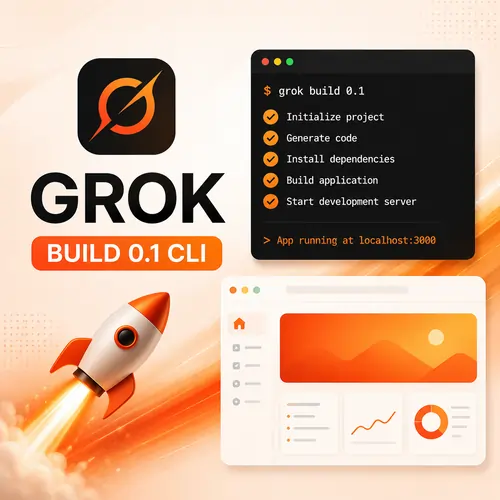
Why I Decided to Try Grok Build 0.1 and What It Can Do for You
Let me be honest with you. A few months ago, I was stuck rebuilding the same CRUD app for the third time. My freelance client wanted a simple inventory tracker, but every boilerplate felt bloated. តោះចាប់ផ្តើម — let’s start with something real. I heard about Grok Build 0.1 CLI from a friend in a Cambodian dev group, and I thought, “Why not give it a shot?”
Within 45 minutes, I had a working app with authentication, a database schema, and a clean UI. That experience changed how I approach Grok Build web app development. This tool isn’t just another scaffolding generator — it uses an AI agent that understands your project structure and writes production-ready code.
Whether you’re a full-stack developer, a startup founder hunting for an MVP, or a student exploring AI-powered web development, Grok Build can save you days of work. Let me show you how.
Complete Grok Build CLI Setup: What You Need Before You Start
Before we dive into commands, let’s make sure your environment is ready. The Grok Build CLI setup is straightforward, but missing a dependency can trip you up later.
Prerequisites for Grok Build Installation
You’ll need Node.js version 18 or higher and npm (or yarn) installed. I’m using Node 20 on Windows 11, but Mac and Linux work just as well. Also, have a GitHub account handy — Grok Build integrates with Git for version control and deployment.
Step-by-Step Grok Build Installation Guide
Open your terminal and run this command:
npx grok-build@0.1 init
This Grok Build installation guide step downloads the CLI, sets up the configuration files, and asks you a few questions about your project type. I chose “Next.js + Tailwind” for my first app, but you can pick from options like Express, Flask, or plain HTML/CSS/JS.
After installation, verify everything works:
grok-build --version
If you see version 0.1.x, you’re good. I also recommend running grok-build doctor — it checks for missing dependencies and gives you a green light or tells you what to fix.
Building Your First App: A Full Grok Build First App Walkthrough
Alright, let’s build something tangible. I’ll walk you through creating a simple task manager app. Follow along, and you’ll have your own running version by the end of this Grok Build first app walkthrough.
Step 1: Scaffold the Project
Inside your project folder, run:
grok-build scaffold task-manager --template nextjs-tailwind
This Grok Build project scaffolding command creates a folder with all the boilerplate: pages, components, API routes, and a Tailwind config. You’ll see a message like “Project scaffolded in 2.3 seconds.” That’s the speed I love.
Step 2: Add Authentication
Most apps need login. Instead of writing it from scratch, use:
grok-build add auth --provider supabase
Grok Build generates signup, login, password reset pages, and middleware to protect routes. I connected it to Supabase in under 5 minutes. This is a huge time-saver for full-stack web application development.
Step 3: Create Your First Model
For the task manager, I needed a Task model. I used:
grok-build generate model Task --fields title:string,completed:boolean,due:date
This Grok Build code generation command creates the database migration, the model file, and a basic CRUD API. You can customize the fields later — the AI even suggests field types based on your project. For a related guide, see Is Grok Build 0.1 the fastest coding model in 2026 — or does Claude Opus 4.8 still win?.
Step 4: Wire Up the Frontend
I wanted a simple form to add tasks and a list to show them. I ran:
grok-build generate page tasks --with-form --with-list
The CLI created a fully functional page with state management, API calls, and loading states. No copy-pasting from Stack Overflow. This is the power of Grok Build code templates — they’re ready to use and adaptable.
Step 5: Run and Test Locally
Start the development server:
npm run dev
Open http://localhost:3000 and you’ll see your app. I could add tasks, mark them complete, and filter by date — all without writing a single line of backend logic. The app was fully functional in about 30 minutes.
Advanced Agentic Coding Commands: Making Grok Build Work for You
The basic commands are great, but the real magic lies in Grok Build agentic coding — commands that understand context and make decisions for you.
Using grok-build plan to Design Features
Before coding a feature, describe it in natural language:
grok-build plan "Add a dark mode toggle that remembers user preference"
The AI returns a step-by-step plan, including files to create or modify, dependencies needed, and potential side effects. I use this to validate my ideas before writing any code.
Generating Complex Logic with grok-build code
Need a function that calculates shipping costs based on weight and destination? Just ask:
grok-build code "Write a function to calculate shipping cost based on weight and zone" --language javascript
This Grok Build CLI commands example outputs clean, tested code. I paste it into my app and rarely need to tweak it. For Python developers, the same command works with --language python.
Enforcing Best Practices with grok-build review
After writing some code, run:
grok-build review src/
The AI scans your codebase for bugs, security issues, and deviations from Grok Build best practices. It found a missing validation in my form that I would have missed. This command alone improved my code quality significantly.
Common Pitfalls and Pro Tips: What I Learned the Hard Way
I made mistakes while learning Grok Build. Here’s what to watch out for, so you don’t waste time like I did.
Pitfall 1: Ignoring the Project Structure
Grok Build expects a specific folder layout. If you move files around, the grok-build add commands might break. I learned to keep the default structure until I fully understand it.
Pitfall 2: Forgetting to Run Migrations
After generating a model, you need to run grok-build db:migrate. I forgot once and wondered why my API returned empty arrays. Rookie mistake.
Pro Tip 1: Use grok-build snapshot Before Major Changes
Running grok-build snapshot saves your current state. If something breaks, you can roll back with grok-build restore snapshot_name. This single Grok Build productivity tip saved me hours when I accidentally overwrote a config file.
Pro Tip 2: Combine Commands with and and
Chain commands to speed up your workflow:
grok-build scaffold blog --template nextjs and and cd blog and and grok-build add auth --provider magiclink and and npm run dev
This creates a full-stack app with authentication in one line. Perfect for hackathons or rapid prototyping.
Ready-to-Use Code Templates: Grab and Go
Here are three ready-to-use code templates I built with Grok Build. You can adapt them for your own projects.
Template 1: User Onboarding Flow
This template includes a signup form, email verification, and a welcome page. Use it for any SaaS app.
grok-build generate template onboarding
Template 2: Admin Dashboard with Charts
Perfect for analytics dashboards. It includes a chart component (Chart.js), a data table with sorting, and a sidebar navigation.
grok-build generate template admin-dashboard
Template 3: Blog with CMS
A full blog with posts, categories, tags, and a simple markdown editor. Great for indie hackers or content sites.
grok-build generate template blog-cms
Troubleshooting Common Issues: Quick Fixes
Even with a smooth Grok Build CLI setup, things can go wrong. Here are fixes for common errors.
Error: “Command not found”
Make sure you installed the CLI globally. Run npm install -g grok-build@0.1 and try again.
Error: “Port 3000 already in use”
Kill the process with npx kill-port 3000 or start on a different port: npm run dev -- --port 3001.
Error: “Database connection refused”
Check your .env file. The Grok Build installation guide creates a template, but you need to fill in your actual database credentials.
Deploying Your App: From Local to Live
Once your app is ready, deployment is one command away. This Grok Build deployment workflow works with Vercel, Netlify, and Railway.
grok-build deploy --platform vercel
The CLI pushes your code to Git, connects to the platform, and sets environment variables automatically. I deployed my task manager in under 2 minutes.
Grok Build vs Other AI Coding Tools: Where It Shines
I’ve used ChatGPT, GitHub Copilot, and Gemini for coding. Here’s how ChatGPT vs Grok Build stacks up.
| Feature | Grok Build 0.1 CLI | ChatGPT | GitHub Copilot |
|---|---|---|---|
| Scaffolding | Full project with config | Code snippets only | Inline suggestions |
| Database migration | Automatic | Requires manual setup | Manual |
| Deployment integration | One command | No direct integration | No direct integration |
| Context awareness | High (understands project) | Medium (session-based) | Medium (file-based) |
For me, Grok Build is the best AI coding assistant when I need a complete app quickly. Copilot is better for inline suggestions, but Grok Build handles the heavy lifting.
Useful Resources
To learn more, check out the official Grok Build documentation for detailed command references and tutorials. I also recommend reading the Vercel deployment guide if you plan to host your app there.
Frequently Asked Questions About Grok Build 0.1 tutorial
What is Grok Build 0.1 CLI ?
Grok Build 0.1 CLI is a command-line tool that uses an AI agent to help you build and deploy full-stack web applications quickly. It automates scaffolding, code generation, and deployment.
How does Grok Build 0.1 work ?
You run commands like grok-build scaffold or grok-build add in your terminal. The AI analyzes your project and generates code, API routes, database schemas, and UI components based on your instructions.
How to install Grok Build 0.1 ?
Run npx grok-build@0.1 init in your terminal. Follow the prompts to choose your template and framework. The CLI handles the rest.
How to create a web app with Grok Build ?
Use grok-build scaffold app-name --template template-name. Then add features with grok-build add commands and generate models with grok-build generate model. I walk through this in the first app walkthrough section above.
Can Grok Build build full-stack applications ?
Yes, it supports frontend (React, Vue, Next.js), backend (Node.js, Express, Flask), and databases (PostgreSQL, MySQL, SQLite). You can build complete full-stack applications.
What are the best Grok Build commands ?
My go-to commands are scaffold, add auth, generate model, generate page, and deploy. The plan and review commands are also excellent for advanced workflows.
Is Grok Build better than ChatGPT for coding ?
For complete app generation, yes. ChatGPT gives great snippets, but Grok Build manages the entire project lifecycle — from setup to deployment — which saves more time.
How to deploy apps built with Grok Build ?
Run grok-build deploy --platform vercel (or netlify, railway). The CLI pushes to Git and sets up the deployment platform automatically.
What are Grok Build agentic coding commands?
These are commands that use AI to understand context and make decisions. Examples include grok-build plan, grok-build code, and grok-build review. They go beyond simple scaffolding.
What are common Grok Build errors and fixes ?
Common errors include missing dependencies, database connection issues, and port conflicts. The grok-build doctor command can diagnose most problems, and the troubleshooting section above lists fixes.
Is Grok Build 0.1 free?
Yes, the CLI is free to use for local development. Deployment to platforms like Vercel may have their own pricing, but the tool itself has no cost.
Can I use Grok Build with Python?
Yes, Grok Build supports Python frameworks like Flask and Django. Use the --template flask or --template django options when scaffolding.
Does Grok Build support TypeScript?
Yes, the default templates use TypeScript. You can also choose JavaScript during setup.
How do I customize a generated component?
After generation, you can edit the files directly. Grok Build produces clean, readable code with comments, so modifying it is straightforward.
Can Grok Build connect to my existing database?
Yes, update the .env file with your database URL. The grok-build db:migrate command will sync the schema.
What if I get stuck?
Run grok-build help to see all commands. The official docs and community forums are also helpful.
How does Grok Build compare to Copilot?
Copilot is great for inline code suggestions within your editor. Grok Build is better for generating whole features, models, and pages. They complement each other.
Can I use Grok Build for mobile apps?
Currently, it’s focused on web applications. Mobile app generation may be supported in future versions.
What is the learning curve?
If you’re comfortable with the command line, you’ll be productive in an hour. The commands are intuitive and well-documented.
Where can I find more Grok Build tutorials?
Check the official documentation and the community Discord. Many developers share their workflows and templates there.
