
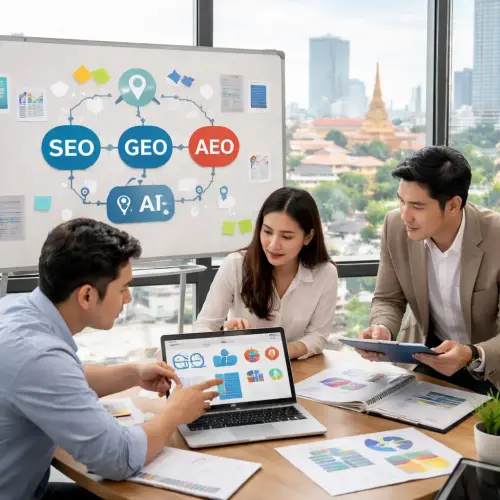
Home / SEO vs GEO vs AEO: What Cambodian Businesses Need to Know in 2026
SEO vs GEO vs AEO Key Takeaways
If you run a business in Cambodia — whether you sell handwoven crafts on Shopee, manage a guesthouse in Siem Reap, or offer digital marketing services from Phnom Penh — you have likely noticed that search behavior is shifting.
- SEO vs GEO vs AEO represent three distinct but complementary approaches: Search Engine Optimization (traditional search), Generative Engine Optimization (AI chat and answer engines), and Answer Engine Optimization (voice assistants and featured snippets).
- Cambodian e-commerce sellers, hotel owners, and local service providers can gain a competitive edge by combining all three strategies in 2026.
- Actionable steps for each audience segment — from freelancers to marketing teams — are included so you can start optimizing today.
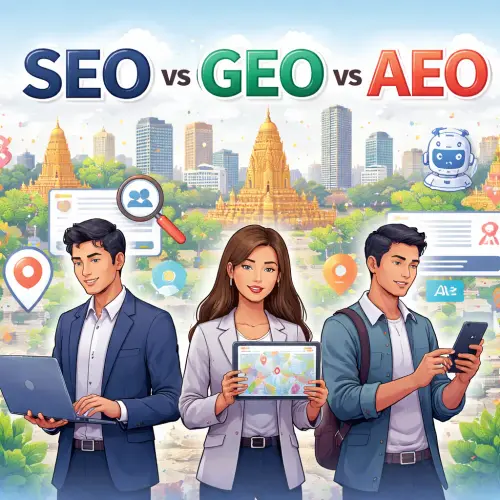
What Readers Should Know About SEO vs GEO vs AEO
If you run a business in Cambodia — whether you sell handwoven crafts on Shopee, manage a guesthouse in Siem Reap, or offer digital marketing services from Phnom Penh — you have likely noticed that search behavior is shifting. People are not only typing keywords into Google. They are asking questions to Siri, chatting with ChatGPT, and using Perplexity to research holiday packages. This is where SEO vs GEO vs AEO becomes critical.
Traditional SEO (Search Engine Optimization) focuses on ranking web pages in Google, Bing, and Yahoo. GEO (Generative Engine Optimization) ensures your brand appears in AI-generated answers from tools like ChatGPT, Gemini, and Claude. AEO (Answer Engine Optimization) targets voice assistants and featured snippets so your business is the source of direct, spoken answers. Each approach requires different tactics, but they share one goal: visibility when and where your customers search.
Why SEO vs GEO vs AEO Matters for Cambodian Businesses in 2026
Cambodia’s digital economy is growing rapidly. Internet penetration surpassed 60% in 2025, and mobile-first usage dominates. At the same time, global adoption of AI search tools is accelerating. By 2026, a Cambodian tourist might ask a voice assistant, “Where is the best boutique hotel in Kampot?” — and the answer will come from an AI model, not a traditional search result. If your business is not optimized for that new conversation, you lose the booking.
For local service providers, e-commerce sellers, and content creators, the practical question is not whether to choose SEO vs GEO vs AEO — but how to integrate all three. In 2026, a bakery in Battambang that appears in Google Maps (SEO), is quoted by ChatGPT for “best Cambodian desserts” (GEO), and answers a voice query about gluten-free num ansom (AEO) will capture customers at every stage of the journey.
How Each Optimization Works in Practice
SEO still relies on keywords, backlinks, technical site health, and local signals like Google Business Profile. GEO requires structuring content in clear, authoritative, quotable formats that AI models trust — think Q and A sections, bulleted lists, and cited data. AEO focuses on concise, conversational answers that voice assistants can read aloud, often drawn from featured snippets or FAQ schemas.
Fortunately, many SEO best practices support GEO and AEO too. A well-written FAQ page, for example, serves all three. The key difference lies in intent: SEO targets a user who types a query; GEO targets an AI that synthesizes information; AEO targets a user who speaks a question.
SEO vs GEO vs AEO: A Comparison Table
| Aspect | SEO (Search Engine Optimization) | GEO (Generative Engine Optimization) | AEO (Answer Engine Optimization) |
|---|---|---|---|
| Primary channel | Google, Bing, Yahoo | ChatGPT, Gemini, Claude, Perplexity | Alexa, Siri, Google Assistant |
| Goal | Rank in organic search results | Be cited in AI-generated answers | Provide direct spoken or snippet answers |
| Key tactic | Keywords, backlinks, technical SEO | Authoritative content, structured data, clear citations | Concise FAQ, schema markup, conversational phrasing |
| Best for | Long-term organic traffic | Brand mentions and trust signals | Voice search and mobile assistants |
| Example for Cambodia | A guesthouse ranking for “cheap hotels in Siem Reap” | ChatGPT quoting the guesthouse’s review snippet | Siri saying “Sokha Hotel has rooms from $40” |
Actionable Steps for Each Audience Segment
No matter which category you fit in, here are targeted actions to implement SEO vs GEO vs AEO in 2026.
For Cambodian Business Owners
Start with SEO basics: claim your Google Business Profile, get customer reviews, and build a simple mobile-friendly website. Then add an FAQ page answering the top five questions customers ask over the phone — this builds your AEO foundation. Finally, write a short authoritative article about your industry (e.g., “Why Cambodian Pepper is the Best in the World”) to improve GEO visibility in AI chat answers.
For Freelancers and Remote Workers
Your personal brand benefits from all three. Keep your LinkedIn and portfolio updated (SEO). Write long-form guides on platforms like Medium or your blog, structured with clear headers and bullets (GEO). Include a FAQ section on your site that answers “What services do you offer?” in a single sentence (AEO).
For E-commerce and Online Sellers
Optimize product pages with rich snippets and reviews (SEO). Create comparison tables and “why choose us” content that AI models can pull for buying guides (GEO). Add a voice-search-friendly return policy and shipping FAQ (AEO). A seller on Khmer24 or Shopee can embed these on their own landing page.
For Tourism and Hospitality Businesses
Tourists increasingly ask AI for recommendations. Publish detailed destination guides with local facts, prices, and transportation tips (SEO). Get listed in reputable travel blogs and directories so AI cites you as a source (GEO). Create short audio-friendly descriptions of your property that can be read by voice assistants (AEO).
For Local Service Providers (Plumbers, Dentists, Tuktuk Drivers)
A strong SEO base with local keywords like “best dentist in Phnom Penh” is essential. Add a Google Q and A section on your Business Profile (AEO). Encourage customers to leave reviews that mention specific services — AI tools look for detailed, positive mentions (GEO).
For Marketing Teams and Digital Agencies
Educate your clients about the shift from single-channel to multi-optimization. Audit your current client campaigns for SEO vs GEO vs AEO gaps. Use tools like Google Search Console (for SEO), Perplexity (to test GEO citations), and voice search simulators (for AEO). Build reports that show performance across all three.
For Content Creators and Bloggers
Write comprehensive, fact-based articles that rank in Google (SEO). Include a “key takeaways” box and a FAQ section in every post (GEO). End each article with a single direct answer to the main question, phrased conversationally (AEO).
For Startups and Entrepreneurs
Focus on SEO to build initial traffic. Use GEO to gain credibility by being quoted in AI answers — this is free PR. Use AEO to capture early adopters who use voice search for quick recommendations. Test which optimization drives the most conversions and double down.
Common Mistakes When Adopting SEO vs GEO vs AEO
One common mistake is treating each optimization as a separate project. In reality, a single piece of well-structured content can serve all three. Another pitfall is ignoring local context: AI models trained on global data may not know Cambodia-specific nuances unless you explicitly include local names, locations, and references. For example, referring to “Psar Thmei market” or “Kampot pepper” strengthens GEO signals. Finally, avoid keyword stuffing — AI engines prioritize clarity and authority over repetition.
How to Avoid These Mistakes
Audit your current content. If you have a FAQ page, update it with conversational answers that match voice queries. If you write blog posts, ensure each post ends with a single clear answer to the title question. If you run an e-commerce store, add structured data markup for products. Small changes create big wins across all three engines.
Useful Resources
- Google SEO Starter Guide – Official best practices for traditional search visibility.
- Perplexity.ai – Test how your brand appears in AI-generated answers and refine your GEO strategy.
Frequently Asked Questions About SEO vs GEO vs AEO
What is the main difference between SEO and GEO?
SEO aims for visibility on search engine result pages, while GEO targets being referenced in AI-generated answers from tools like ChatGPT.
What does AEO stand for in digital marketing?
AEO stands for Answer Engine Optimization, which optimizes content for voice assistants and featured snippets.
Which is more important for Cambodian businesses in 2026: SEO, GEO, or AEO?
All three matter. SEO remains essential for organic reach, GEO is growing rapidly with AI adoption, and AEO captures voice and mobile users.
Can I use the same content for SEO, GEO, and AEO?
Yes, well-structured content with clear headings, concise answers, and authoritative citations serves all three.
How does GEO affect e-commerce stores in Cambodia?
GEO helps AI tools recommend your store when users ask for product comparisons or buying advice, increasing trust and traffic.
Is AEO only for voice search?
Not entirely. AEO also targets featured snippets, knowledge panels, and Google Q and A boxes that appear in traditional search.
Do I need to know coding to implement GEO?
No, but familiarity with structured data (schema markup) and content formatting helps.
How do I measure GEO success?
Use tools like Brand24 to track brand mentions in AI answers, and monitor referral traffic from AI-based search tools.
What is the first step for a Cambodian startup to start with AEO?
Create an FAQ page answering common customer questions in 1-2 sentences, and add FAQ schema markup to your site.
Does GEO work for local service providers?
Yes, especially when you include location-specific details that AI models can cite, such as neighborhood names and service prices.
How long does it take to see results from GEO?
Results can appear within weeks if your content is highly authoritative and matches common AI queries, but consistent effort over months yields stronger gains.
Should I stop investing in SEO and focus only on GEO and AEO?
No, SEO still drives the majority of web traffic. GEO and AEO are complementary strategies, not replacements.
Can AI generate GEO-optimized content for me?
AI tools can help draft content, but human editing is needed to ensure accuracy, local relevance, and trustworthiness.
What kind of content works best for AEO?
Short, direct answers to common questions — like “How much does a tuktuk ride cost in Phnom Penh?” — work best.
How do I optimize for GEO without being too technical?
Focus on writing clear, well-structured content with facts, statistics, and citations. AI models prioritize clarity over technical complexity.
Is GEO the same as SEO for voice search?
No. Voice search is part of AEO, while GEO covers all generative AI outputs including text, chat, and image generation.
What tools can help me implement GEO for my Cambodian business?
Use Perplexity to test brand mentions, Google’s Natural Language API for content analysis, and schema.org for structured data.
Can I outsource SEO, GEO, and AEO to an agency?
Yes, but ensure the agency understands the Cambodian market and uses local-specific optimization tactics, not generic global approaches.
How often should I update my content for GEO?
Update key pages every 3-6 months to keep facts current, as AI models favor fresh, accurate information.
Will AEO replace traditional SEO entirely?
No, but the balance is shifting. AEO will grow in importance, especially for mobile and voice users, while SEO remains the backbone of discoverability.
Conclusion
The landscape of search is no longer a single road. By 2026, SEO vs GEO vs AEO will define how Cambodian businesses connect with customers across traditional search engines, AI chatbots, and voice assistants. The winners will be those who adapt early, test constantly, and create content that serves humans and machines equally.
Now it’s your turn: which optimization will you prioritize first for your business or career? Share your thoughts in the comments — and if you found this guide helpful, pass it to a fellow entrepreneur in Cambodia.
